
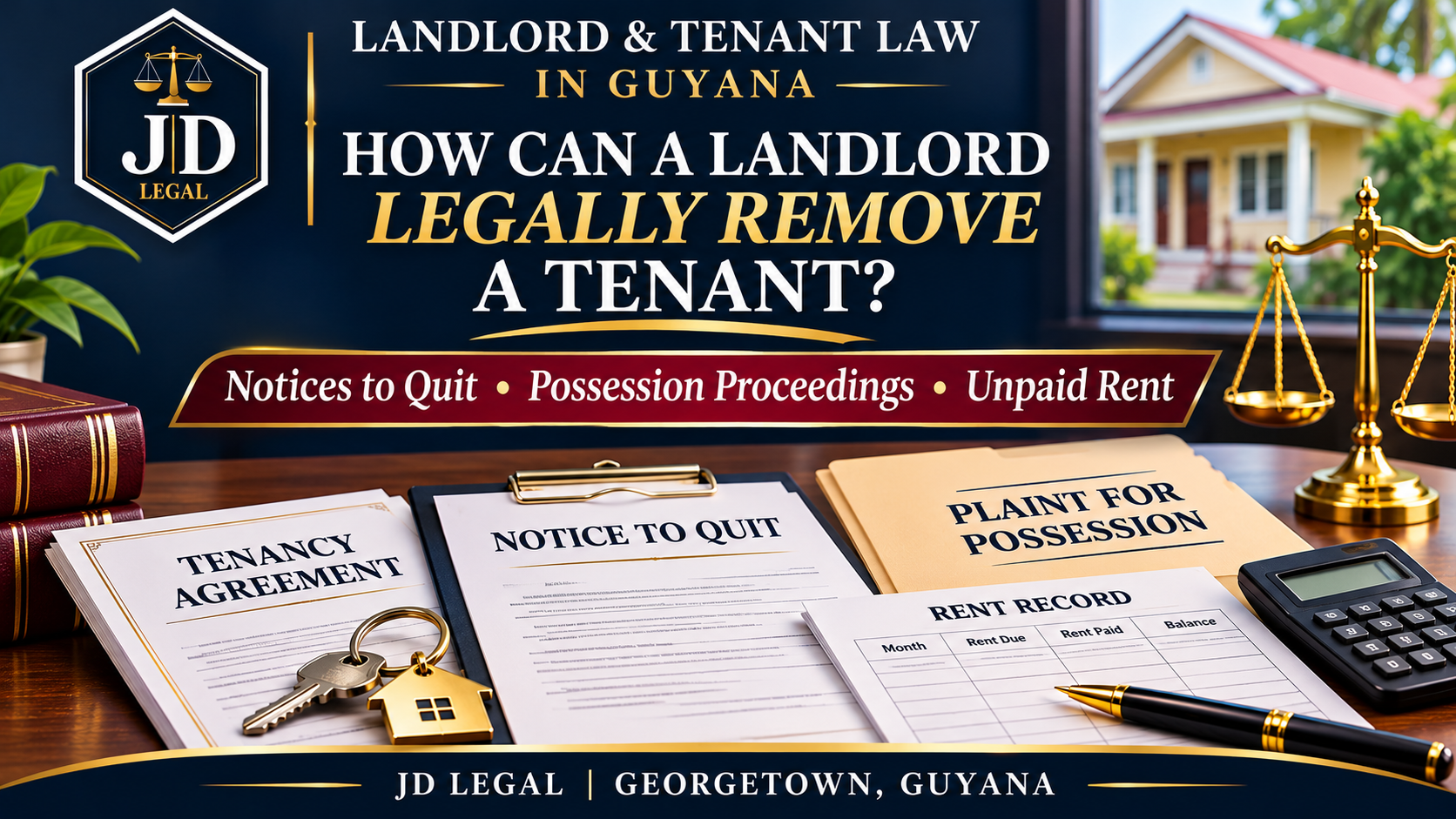
Owning rental property can be a valuable investment, but dealing with a tenant who fails to pay rent, breaches the tenancy agreement or refuses to leave can be frustrating and financially damaging.
Many landlords in Guyana are unsure of the legal steps they must take to recover possession of their properties. Some attempt to remove tenants themselves, change locks or disconnect utilities, without appreciating the potential legal consequences.
In Guyana, landlords have legal remedies available to recover possession of their properties and outstanding rent. However, these remedies must be pursued in accordance with the applicable laws and court procedures.
At JD Legal, we assist landlords with Notices to Quit, Plaint for Possession, recovery of rent owed, ejection applications and other landlord and tenant matters.
1. Can a Landlord Legally Evict a Tenant in Guyana?
Yes. A landlord may recover possession of rental property where there are lawful grounds to terminate the tenancy and the appropriate legal procedures have been followed.
The principal legislation governing landlord and tenant relationships includes:
The Landlord and Tenant Act, Chapter 61:01.
The Rent Restriction Act, Chapter 36:23.
The applicable principles of contract law.
The particular procedure will depend on the tenancy agreement, the type of tenancy, the circumstances of the termination and whether the premises are covered by the Rent Restriction Act.
Common circumstances in which a landlord may seek to recover possession include:
Failure to pay rent.
Breach of the tenancy agreement.
Expiration of a fixed-term tenancy.
Nuisance or conduct affecting neighbouring occupiers.
Use of the premises for unlawful purposes.
Other grounds recognised by the applicable law.
Importantly, a landlord must establish a lawful basis for recovering possession. The fact that a landlord owns the property does not automatically entitle them to remove a tenant without following the proper process.
2. What Is a Notice to Quit?
A Notice to Quit is a formal notice given by a landlord requiring a tenant to vacate rental premises by a specified date.
It is commonly used to terminate periodic tenancies, such as monthly or weekly tenancies, in accordance with the applicable notice requirements.
A Notice to Quit may be necessary where:
A landlord wishes to terminate a periodic tenancy.
A tenant has breached the tenancy agreement.
The landlord wishes to recover possession following the lawful termination of the tenancy.
The notice period will depend on the nature of the tenancy, the agreement between the parties and the applicable law.
For example, guidance published by the Guyana Association of Women Lawyers refers to at least four weeks' notice for a periodic tenancy, expiring at the end of a completed tenancy period. However, this should not be treated as a universal notice period for every tenancy.
Where a fixed-term tenancy has expired, a separate Notice to Quit may not be necessary, depending on the agreement and applicable law.
A Notice to Quit should be properly drafted and served. An incorrectly prepared or served notice may affect subsequent possession proceedings.
3. What Happens If a Tenant Ignores a Notice to Quit?
Serving a Notice to Quit does not automatically remove a tenant from the property.
If the notice expires and the tenant refuses to vacate, the landlord may need to commence legal proceedings to recover possession.
Depending on the circumstances, this may involve filing a Plaint for Possession or another appropriate possession claim before the competent court.
The landlord will generally need to establish:
Their legal entitlement to possession.
The existence and nature of the tenancy.
The grounds relied upon for terminating the tenancy.
That the required notice was properly given, where applicable.
That the tenant has failed or refused to deliver up possession.
The court will consider the evidence and determine whether the landlord is legally entitled to recover possession.
The appropriate procedure must be determined with reference to the applicable legislation and the nature of the tenancy.
4. What Is a Plaint for Possession?
A Plaint for Possession is a legal claim brought by a landlord seeking an order from the court requiring a tenant or occupier to give up possession of rental property.
It is an important legal remedy where a tenant remains in occupation after the tenancy has lawfully ended.
The Landlord and Tenant Act provides for proceedings to recover possession in specified circumstances, including under section 46.
The court may consider evidence relating to the tenancy, its termination and the landlord's entitlement to possession.
Where appropriate, a claim for arrears of rent and other damages may also be pursued. Section 46(4) of the Landlord and Tenant Act expressly permits certain related monetary claims to be joined in proceedings brought under that section.
Not every tenancy will fall within the specific summary procedure under section 46. The appropriate court process must therefore be established before proceedings are commenced.
5. Can a Landlord Recover Unpaid Rent From a Tenant?
Yes. A landlord may pursue legal recovery of rent that is lawfully due and remains unpaid.
Rent arrears can create serious financial difficulties, particularly for landlords who depend on rental income to meet mortgage payments, property expenses and other financial obligations.
Where a tenant fails to pay rent, a landlord should:
Step 1: Establish the Outstanding Balance
Prepare a clear record of the rent due, payments received and the outstanding balance.
Step 2: Gather Supporting Evidence
Collect the tenancy agreement, rent receipts, bank records, payment confirmations and relevant communications with the tenant.
Step 3: Make a Formal Demand for Payment
A written demand should clearly state the outstanding amount and request payment within an appropriate period.
Step 4: Obtain Legal Advice
An attorney can advise on the appropriate legal proceedings to recover the outstanding rent and whether a claim for possession should also be pursued.
Step 5: Commence Recovery Proceedings
Where the tenant fails to pay, legal proceedings may be commenced to recover the outstanding amount.
A landlord should not assume that terminating the tenancy automatically extinguishes the tenant's outstanding rental obligations.
6. What Is an Ejection Application?
An Ejection Application is a further legal step that may become necessary where a tenant or occupier refuses to leave even after the court has ordered possession to be delivered to the landlord.
Under section 46 of the Landlord and Tenant Act, where the relevant statutory procedure applies, a magistrate may issue a warrant of ejectment if the former tenant or occupier fails to deliver possession within the period directed by the court.
The warrant authorises a constable or bailiff to execute the order and deliver possession to the landlord.
This is an important distinction: obtaining an order for possession and physically recovering possession are separate stages of the legal process.
A landlord should not personally force the tenant out.
7. Can a Landlord Change the Locks, Remove Doors or Disconnect Utilities?
No. A landlord should not attempt to force a tenant out by taking matters into their own hands.
Changing locks, removing doors, interfering with the roof or otherwise disturbing the tenant's peaceful enjoyment of the premises may expose the landlord to legal consequences.
Section 60 of the Landlord and Tenant Act specifically prohibits a landlord or agent from removing the roof, window, door or other part of a tenement during the tenancy, except with the tenant's consent or in the execution of a duty to repair.
The Attorney General has also publicly warned landlords against using measures such as cutting off water supplies or interfering with utilities to force tenants to leave.
Even where rent is outstanding or the tenancy has ended, landlords must follow the lawful process for recovering possession.
Obtaining a court order and, where necessary, a warrant of ejectment is the appropriate route.
8. What Documents Should a Landlord Prepare?
If you are experiencing difficulties with a tenant, it is important to keep proper records.
Documents that may be useful include:
Tenancy agreement.
Identification and contact details of the tenant.
Copy of the Notice to Quit.
Evidence of service of the notice.
Rent payment records.
Schedule of outstanding rent.
Receipts and bank transfer confirmations.
Written demands for payment.
WhatsApp messages, emails and other relevant communications.
Photographs or reports documenting damage to the property, where applicable.
Previous correspondence relating to breaches of the tenancy agreement.
Keeping these documents organised can assist an attorney in assessing the matter and preparing the appropriate legal proceedings.
9. How Can JD Legal Assist Landlords?
JD Legal provides legal services to landlords seeking to protect their property interests and resolve tenancy-related disputes in Guyana.
Our Landlord & Tenant Law services include:
Notices to Quit
Preparation of Notices to Quit and advice on the lawful termination of tenancies.
Plaint for Possession
Legal assistance with proceedings to recover possession of rental property.
Recovery of Rent Owed
Assistance with legal claims to recover outstanding rental payments.
Ejection Applications
Assistance with the legal process required to obtain possession where a tenant refuses to comply with a court order.
Tenancy Agreements
Drafting and reviewing tenancy agreements to help protect the interests of landlords and tenants.
Property Management
Property management services and assistance with the legal and administrative aspects of managing rental properties.
Landlord and Tenant Dispute Resolution
Legal advice and assistance with tenancy breaches, rental disputes and other landlord and tenant matters.
Frequently Asked Questions About Evicting a Tenant in Guyana
Can I evict a tenant for failing to pay rent?
Failure to pay rent may provide grounds for a landlord to seek possession, subject to the applicable legislation, tenancy agreement and court procedure.
How much notice must I give a tenant to leave?
The required notice depends on the type of tenancy, the agreement and applicable law. For many periodic tenancies, four weeks' notice ending at the appropriate tenancy period is commonly referred to in Guyanese legal guidance. Obtain legal advice before serving notice.
Can I physically remove a tenant after the Notice to Quit expires?
No. Expiration of the notice does not authorise you to physically remove the tenant. If the tenant refuses to leave, appropriate court proceedings may be necessary.
Can I sue a tenant for unpaid rent and recover possession at the same time?
In certain proceedings, possession and monetary claims may be brought together. The appropriate procedure will depend on the circumstances and applicable legislation.
What if the tenant refuses to leave after the court orders possession?
A warrant of ejectment may be necessary. Where the relevant statutory procedure applies, the warrant is executed by a constable or bailiff.
Can an overseas landlord take legal action against a tenant in Guyana?
Yes. An overseas property owner may seek legal assistance in Guyana to pursue appropriate remedies. An attorney can advise on the documents and authority required to act on the landlord's behalf.
Is Your Tenant Refusing to Pay Rent or Leave Your Property?
You do not have to navigate landlord and tenant disputes alone.
Whether you need a Notice to Quit, a Plaint for Possession, recovery of unpaid rent or an Ejection Application, JD Legal can assist you in understanding your legal options and taking the appropriate steps.
Book a Free Discovery Call
At JD Legal, we offer a complimentary Discovery Call with no fees or obligations attached.
During the call, we will discuss your legal issues and determine whether we can move forward.
JD LEGAL
Tiffany Jeffrey-Durant
Attorney-at-Law
65 Fifth Street, Albertown, Georgetown, Guyana.
Telephone/WhatsApp: +592 752 4073
Email: jdlegalgy@gmail.com
Legal Disclaimer: This article is provided for general informational purposes only and does not constitute legal advice. The rights of landlords and tenants depend on the type of tenancy, the applicable legislation and the circumstances of each matter. Obtain legal advice before terminating a tenancy or commencing possession proceedings.
